
DO COMMUTING ACCIDENTS VARY BY DAY OF THE WEEK? EXPLORING THE 'MONDAY AND WEEKDAY EFFECTS' IN ECUADOR
¿Varían
los accidentes in itínere según el día de la semana? Explorando los “efectos
del lunes y de los días laborables” en Ecuador
Os acidentes de trajeto variam conforme o dia da semana? Explorando os “efeitos
da segunda-feira e dos dias úteis” no Equador
Antonio Ramón
Gómez-García1
1 Facultad de Postgrados, Universidad Espíritu Santo. Samborondón-Ecuador. Correo: agomezg@uees.edu.ec
Fecha de recepción: 29 de agosto de 2025.
Fecha de aceptación: 20 de octubre de 2025.
ABSTRACT
INTRODUCTION. Commuting accidents, defined as those occurring during the usual journey between home and the workplace or vice versa, may cluster or vary across working days. However, in Ecuador, evidence on these temporal patterns remains limited. OBJECTIVE. To assess the presence of the 'Monday effect' and the 'Weekday effect' in commuting accident injuries in Ecuador, and to explore heterogeneity by sex and age group. METHOD. Exploratory study based on administrative records from 2023–2024 (n = 3,469). Daily proportions (95% CI), relative index (Monday = 100), and linear trends (β, R²) of commuting accidents during peak commuting hours (Monday to Friday) were estimated. Differences between consecutive days were assessed using the Z statistic (p < 0.05). RESULTS. Men accounted for the majority of accidents (61%). Among women ≤29 years, a significant increase was observed on Tuesday compared with Monday (p < 0.05), while among men ≥50 years, a significant downward trend from Monday to Friday was detected (β = −7.67; R² = 0.871; p = 0.020). In other groups, variations were not statistically significant. DISCUSSION AND CONCLUSIONS. Commuting accidents in Ecuador show a homogeneous distribution across the working week, with no confirmation of the temporal patterns analyzed, though vulnerable subgroups were identified. Longitudinal studies are needed to further examine these findings and support targeted preventive measures focused on mobility during peak hours.
Keywords: commuting accidents, monday effect, weekday effect, occupational road safety, Ecuador.
RESUMEN
INTRODUCCIÓN. Los accidentes in itínere, definidos como aquellos que ocurren durante el trayecto habitual entre el domicilio y el lugar de trabajo o viceversa, pueden concentrarse o variar a lo largo de los días laborables. Sin embargo, en Ecuador la evidencia sobre estos patrones temporales es limitada. OBJETIVO. Evaluar la presencia del “efecto lunes” y del “efecto día de la semana” en las lesiones por accidentes in itínere en Ecuador, y explorar la heterogeneidad según sexo y grupo de edad. MÉTODO. Estudio exploratorio basado en registros administrativos de 2023–2024 (n = 3.469). Se estimaron proporciones diarias (IC 95%), índice relativo (lunes = 100) y tendencias lineales (β, R²) de los accidentes in itínere ocurridos durante las horas pico de desplazamiento (lunes a viernes). Las diferencias entre días consecutivos se evaluaron mediante la estadística Z (p < 0,05). RESULTADOS. Los hombres representaron la mayoría de los accidentes (61%). Entre las mujeres ≤29 años se observó un incremento significativo el martes respecto al lunes (p < 0,05), mientras que en los hombres ≥50 años se detectó una tendencia descendente significativa de lunes a viernes (β = −7,67; R² = 0,871; p = 0,020). En los demás grupos, las variaciones no fueron estadísticamente significativas. DISCUSIÓN Y CONCLUSIONES. Los accidentes in itínere en Ecuador presentan una distribución homogénea a lo largo de la semana laboral, sin confirmación de los patrones temporales analizados, aunque se identificaron subgrupos vulnerables. Se requieren estudios longitudinales para profundizar en estos hallazgos y respaldar medidas preventivas dirigidas a la movilidad durante las horas pico.
Palabras clave: accidentes in itínere, efecto lunes, efecto día de la semana, seguridad vial laboral, Ecuador.
RESUMO
INTRODUÇÃO. Os acidentes de trajeto, definidos como aqueles que ocorrem durante o percurso habitual entre a residência e o local de trabalho ou vice-versa, podem se concentrar ou variar ao longo dos dias úteis. No entanto, no Equador, as evidências sobre esses padrões temporais ainda são limitadas. OBJETIVO. Avaliar a presença do “efeito segunda-feira” e do “efeito dia da semana” nas lesões por acidentes de trajeto no Equador, e explorar a heterogeneidade segundo sexo e faixa etária. MÉTODO. Estudo exploratório baseado em registros administrativos de 2023–2024 (n = 3.469). Foram estimadas proporções diárias (IC 95%), índice relativo (segunda-feira = 100) e tendências lineares (β, R²) dos acidentes de trajeto ocorridos nos horários de pico de deslocamento (segunda a sexta-feira). As diferenças entre dias consecutivos foram avaliadas por meio da estatística Z (p < 0,05). RESULTADOS. Os homens representaram a maioria dos acidentes (61%). Entre as mulheres ≤29 anos observou-se um aumento significativo na terça-feira em comparação à segunda-feira (p < 0,05), enquanto nos homens ≥50 anos foi detectada uma tendência decrescente significativa de segunda a sexta-feira (β = −7,67; R² = 0,871; p = 0,020). Nos demais grupos, as variações não foram estatisticamente significativas. DISCUSSÃO E CONCLUSÕES. Os acidentes de trajeto no Equador apresentam uma distribuição homogênea ao longo da semana de trabalho, sem confirmação dos padrões temporais analisados, embora tenham sido identificados subgrupos vulneráveis. São necessários estudos longitudinais para aprofundar esses achados e apoiar medidas preventivas direcionadas à mobilidade nos horários de pico.
Palavras-chave: acidentes de trajeto, efeito segunda-feira, efeito dia da semana, segurança viária ocupacional, Equador.
INTRODUCTION
In many countries, social security systems recognise injuries sustained during the regular commute between home and the workplace as occupational accidents (community accidents). Beyond their legal implications, commuting accidents are a significant public health concern. They impose a substantial burden of morbidity and mortality on the workforce, resulting in considerable economic consequences, primarily through increased healthcare costs and reduced enterprise productivity [1–4]. In light of their considerable magnitude, both the International Labour Organization and the World Health Organization acknowledge commuting accidents as a priority concern for both occupational and public health. This underscores the necessity for their incorporation into national occupational road safety agendas [5–7].
The majority of commuting accidents result in temporary disability, with a disproportionate incidence observed among younger workers [8–10]. Major risk factors include the mode of transportation (motorcycle and pedestrian), the length of the commute, and the high traffic density during peak hours [3,4,10]. In addition to individual risk factors, the analysis of temporal patterns has emerged as a key approach to understanding the distribution of commuting accidents throughout the working week.
One of the most extensively studied phenomena in occupational epidemiology for understanding the temporal patterns of accidents is the so-called 'Monday effect'. This refers to the observation of a higher frequency of accidents on Mondays, followed by a progressive decline as the working week advances [11,12]. Complementarily, the so-called 'Weekday effect' has been proposed, which describes the proportional variations in accidents between consecutive working days. This phenomenon is particularly useful for detecting increases or decreases on specific days that might remain unnoticed in an analysis restricted solely to the 'Monday effect' [13].
Although both phenomena have been examined in relation to workplace accidents, the evidence specific to commuting accidents remains limited. Considering both phenomena together provides a valuable tool in occupational road safety, as it allows the identification of critical moments within the working week and supports the design of more targeted preventive strategies on specific days [9].
In the Republic of Ecuador, the available evidence on commuting accidents remains limited [14], and, to the best of our knowledge, neither the 'Monday effect' nor the 'Weekday effect' has been evaluated in this context. Accordingly, the present study aims to jointly test two hypotheses. The first (Hypothesis 1) posits that commuting accidents are more concentrated on Mondays and progressively decrease as the working week advances, consistent with the so-called 'Monday effect'. The second (Hypothesis 2) proposes that the proportion of such accidents varies significantly across the working days, thereby supporting the existence of a 'Weekday effect'.
The joint testing of both hypotheses, conducted for the first time in the country, could more precisely guide the design of occupational road safety campaigns targeted at commuting periods between home and the workplace among the working population.
METHODOLOGY
An exploratory observational study was conducted using anonymized administrative records of commuting accidents qualified by the General Occupational Risk Insurance in 2023 and 2024. It is important to note that these are the only years for which information on the hour of the accident and temporary disability is available.
To ensure comparability across working days, three inclusion criteria were applied (Figure 1). First, only accidents occurring during standard commuting hours were considered, specifically between 5:00 and 8:59 (journey to work) and between 16:00 and 19:59 (return home): 5,392 cases (77.1% of 6,993). Second, the analysis was restricted to accidents occurring during the standard working week (Monday to Friday), reducing the number of cases to 4,711 (87.4% of 5,392). Finally, only accidents that resulted in injuries causing at least one day of temporary disability were included, yielding a final sample of 3,469 cases (73.6% of 4,711).
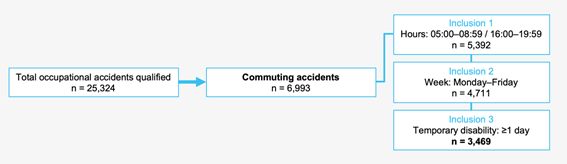
Figure 1. Flow diagram of commuting accidents selected for inclusion in the analysis.
To test the proposed hypotheses, we adopted the methodology described in previous studies [11,13]. For Hypothesis 1, daily proportions of commuting accidents relative to the total for the working week were estimated, together with their 95% confidence intervals (95% CI). A linear trend across the week was subsequently assessed using ordinary least squares regression, estimating both the coefficient of determination (R²) and the slope (β), with Monday taken as the reference day (relative index = 100). For Hypothesis 2, proportional differences between consecutive days (Tuesday vs. Monday, Wednesday vs. Tuesday, etc.) were compared using the Z statistic (critical value = 1.96).
Detailed results of these analyses are presented in the Supplement. In the figures provided in the Results section, the relative index of commuting accidents for each working day is shown, highlighting significant changes between consecutive days.
Statistical analyses were performed using Jamovi software (version 2.3.21.0), and figures were produced with Microsoft Excel (version 16.78). Analyses were stratified by age group, with separate evaluations for women and men, applying a statistical significance level of p < 0.05. The study was reviewed by the General Occupational Risk Insurance of the Ecuadorian Social Security Institute.
RESULTS
Figure 2 shows the distribution of the 3,469 accidents by working day and by commuting periods in the morning (05:00–08:59) and afternoon (16:00–19:59). A higher concentration of accidents was observed on Monday and Wednesday mornings, as well as on Tuesday and Wednesday afternoons, followed by a decline on Thursday and Friday. Women accounted for 39% of the cases, with a higher concentration from the age of 30 onwards, whereas among men accidents occurred more frequently in those under 40 years of age (Figure 3).
Figure 4 shows the relative index of commuting accidents with Monday as the reference (=100) among women. No 'Monday effect' (Hypothesis 1) was observed, although the frequency displayed a downward trend toward Friday, which was not statistically significant (see Supplement). The pattern most consistent with a 'Monday effect' was found among women aged 30–39 years (β = −8.78, R² = 0.692, p = 0.081) and 40–49 years (β = −7.62, R² = 0.755, p = 0.056). Regarding the 'Weekday effect' (Hypothesis 2), a significant increase was observed on Tuesday (vs. Monday) among women aged ≤29 years. For the remaining age groups, this effect was only evident on Friday (vs. Thursday).
Among men (Figure 5), a downward trend from Monday to Friday was observed across all age groups (see Supplement). However, this trend was statistically significant only in workers aged ≥50 years (β = −7.67; R² = 0.871; p = 0.020). Consequently, the presence of the 'Monday effect' (Hypothesis 1) was not confirmed in most age groups. In the analyses of significant changes between consecutive days, the 'Weekday effect' (Hypothesis 2) was observed only when comparing Friday with Thursday, and solely among workers younger than 50 years.
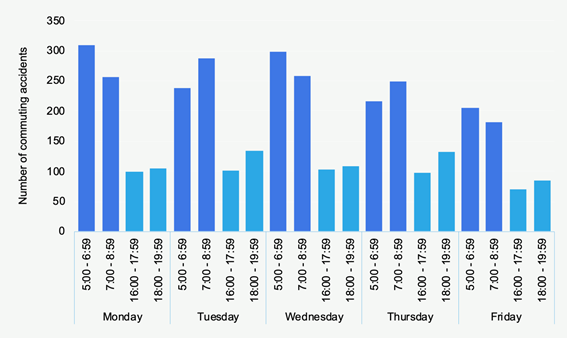
Figure 2. Hourly distribution of commuting accidents during the working week (n = 3,469).
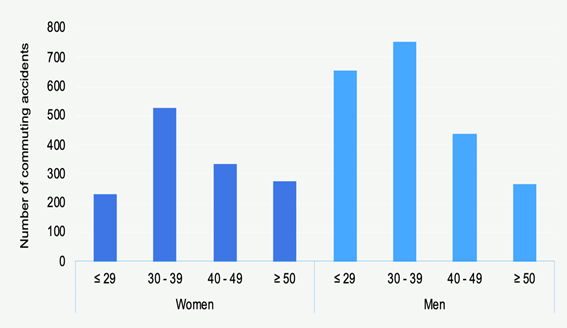
Figure 3. Distribution of commuting accidents by sex and age group.
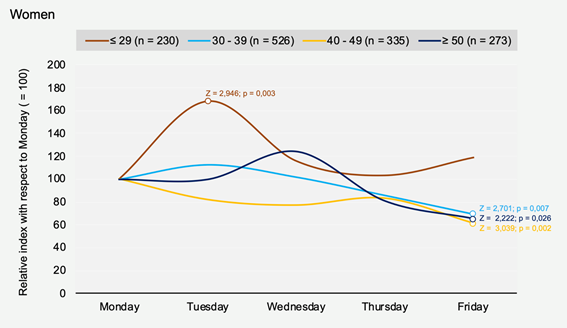
Figure 4. Relative weekly variation (Monday = 100) of commuting accidents among women by age group.

Figure 5. Relative weekly variation (Monday = 100) of commuting accidents among men by age group.
DISCUSSION AND CONCLUSIONS
This study analyzed administrative records of injuries from commuting accidents resulting in temporary disability in the Republic of Ecuador, with the aim of jointly testing two hypotheses. Overall, the results allowed us to reject both hypotheses: neither the existence of a 'Monday effect' (Hypothesis 1) nor a 'Weekday effect' (Hypothesis 2) was confirmed.
In contrast to reports from other countries [9,13], although our analyses do not allow causal explanations, the frequency of commuting accidents appears to remain constant throughout the working week, regardless of the day. By contrast, the temporal patterns by time of day (Figure 2) are consistent with those described in previous studies. The high traffic density observed during peak hours, between 5:00 and 9:00 and between 17:00 and 19:00 [13,16–19], reflects the homogeneity of work start and end times across most economic activities.
The sex-stratified analysis revealed that men accounted for the majority of commuting accidents (Figure 3), consistent with previous studies highlighting their greater exposure to motorized means of transportation [8,20,21]. However, in both men and women, the weekly distribution was similar (Figures 4 and 5), in line with recent research indicating that traffic conditions exert a comparable influence on both sexes [22].
Among young women under 30 years of age (Figure 4), an increase in commuting accidents was observed on Tuesday compared with Monday. Although unexpected, this finding could be related to the participation of this age group in hospitality and commerce activities, where Monday is often a day off, as well as to the higher traffic density reported on Tuesdays compared with Mondays [23]. In addition, the potential influence of psychosocial factors cannot be ruled out. Nevertheless, these explanations should be examined in future research.
This study has some limitations that should be considered when interpreting the results. First, it was based on administrative records of workers affiliated with the social security system, which implies a possible underreporting of non-reported accidents. Second, the information was limited to the 2023–2024 period and did not include additional variables, restricting the possibility of conducting more detailed analyses. Third, the analyses were restricted to commuting periods at the beginning and end of the working day, which entailed the exclusion of events occurring outside these intervals. Nevertheless, these time windows correspond to standard mobility peaks.
In conclusion, commuting accidents in the Republic of Ecuador exhibit a relatively homogeneous distribution across the working days, with no consistent differences by age or sex. As this is an exploratory study, it would be premature to propose specific preventive actions solely on the basis of the present findings. At this stage, priority should be given to strengthening workers’ awareness and sensitization regarding road risks during peak hours, a responsibility that primarily falls on enterprises within the scope of their preventive obligations. These actions should be complemented by nationwide campaigns jointly coordinated by the General Occupational Risk Insurance, the Occupational Safety and Health and Risk Prevention Directorate of the Ministry of Labour, and the National Transit Agency.
FUNDING
This research received no external funding.
CONFLICT OF INTEREST
The author declares that the research was conducted in the absence of any commercial or financial relationships that could be construed as a potential conflict of interest.
CONTRIBUTION OF THE ARTICLE TO THE RESEARCH LINE
This article contributes to the research line on occupational road safety in Ecuador by analyzing, for the first time in the country, the presence of the 'Monday effect' and the 'Weekday effect' in commuting accidents. The study guides preventive strategies during peak commuting hours and opens a field of longitudinal research on occupational accident patterns.
AUTHOR CONTRIBUTIONS
ARGG: Conceptualization, Writing – original draft, Writing – review & editing.
GENERATIVE AI STATEMENT
The author declare that no Gen AI was used in the creation of this manuscript.
DATA AVAILABILITY
The dataset is not publicly available due to institutional agreements; however, it can be obtained from the corresponding author upon reasonable request. It was created exclusively for research purposes as part of a research agreement between the Ecuadorian Observatory of Occupational Safety and Health at Universidad Espíritu Santo and the General Directorate of Occupational Risks of the Ecuadorian Social Security Institute.
REFERENCES
[1] J. Llamazares, S. A. Useche, L. Montoro, y F. Alonso, «Commuting accidents of Spanish professional drivers: When occupational risk exceeds the workplace», International Journal of Occupational Safety and Ergonomics, vol. 27, n.º 3, pp. 754–762, 2019, doi: 10.1080/10803548.2019.1619993.
[2] A. Sabz Tajari, I. Masoudi Asl, y S. Hessam, «An investigation of work-related accidents and its effects on the costs of Social Security Organization over the period of 2012–2016», Journal of Health Sciences & Surveillance System, vol. 7, n.º 1, pp. 36–39, 2019, doi: 10.30476/jhsss.2020.85114.1058.
[3] A. Ponsin, E. Fort, M. Hours, B. Charbotel, y M. A. Denis, «Commuting accidents among non-physician staff of a large university hospital center from 2012 to 2016: A case-control study», International Journal of Environmental Research and Public Health, vol. 17, n.º 9, p. 2982, 2020, doi: 10.3390/ijerph17092982.
[4] A. Ponsin, E. Fort, M. Hours, B. Charbotel, y M. A. Denis, «Incidence of commuting accidents among non-physician staff in a large French university hospital centre from 2012 to 2016», Work, vol. 76, n.º 2, pp. 867–876, 2023, doi: 10.3233/WOR-210815.
[5] L. Swepston, «The International Labor Organization: Human rights to health and safety at work», en Human rights in global health: Rights-based governance for a globalizing world, B. M. Meier y L. O. Gostin, Eds. Oxford: Oxford University Press, 2018, pp. 281–300, doi: 10.1093/oso/9780190672676.003.0010.
[6] A. A. Mohammed, K. Ambak, A. M. Mosa, y D. Syamsunur, «A review of traffic accidents and related practices worldwide», The Open Transportation Journal, vol. 13, n.º 1, pp. 65–79, 2019, doi: 10.2174/1874447801913010065.
[7] World Health Organization, Global plan for the decade of action for road safety 2021–2030. Geneva: World Health Organization, 2021. [Online]. Available at: https://cdn.who.int/media/docs/default-source/documents/health-topics/road-traffic-injuries/global-plan-for-road-safety.pdf
[8] B. Charbotel, J. L. Martin, y M. Chiron, «Work-related versus non-work-related road accidents, developments in the last decade in France», Accident Analysis and Prevention, vol. 42, n.º 2, pp. 604–611, 2010, doi: 10.1016/j.aap.2009.10.006.
[9] C. Giliberti y S. Salerno, «Differenze di genere negli infortuni in itinere: Analisi dei casi mortali dalla Banca Dati Statistica INAIL (2009–2013) [Gender differences and commuting accidents in Italy: INAIL Data Base analysis on fatalities (2009–2013)]», La Medicina del Lavoro, vol. 107, n.º 6, pp. 462–472, 2016. [Online]. Available at: https://www.mattioli1885journals.com/index.php/lamedicinadellavoro/article/view/5339/4143.
[10] S. Salerno y C. Giliberti, «When being a woman represents a major risk of commuting accidents?», en Proceedings of the 20th Congress of the International Ergonomics Association (IEA 2018). Advances in Intelligent Systems and Computing, S. Bagnara, R. Tartaglia, S. Albolino, T. Alexander, y Y. Fujita, Eds. Cham: Springer, 2019, vol. 826, pp. 274–281, doi: 10.1007/978-3-319-96065-4_34.
[11] I. Fontaneda, M. A. Camino López, O. J. González Alcántara, y B. A. Greiner, «The “Weekday Effect”: A decrease in occupational accidents from Monday to Friday—An extension of the “Monday Effect”», BioMed Research International, 2024, p. 4792081, doi: 10.1155/2024/4792081.
[12] A. Elfering, C. Gerhardt, D. Pereira, et al., «The Monday effect revisited: A diary and sleep actigraphy study», Sleep Vigilance, vol. 4, pp. 167–176, 2020, doi: 10.1007/s41782-020-00105-5.
[13] M. Poland, I. Sin, y S. Stillman, «Why are there more accidents on Mondays? Economic incentives, ergonomics or externalities», Frontiers in Behavioral Economics, vol. 4, p. 1541497, 2025, doi: 10.3389/frbhe.2025.1541497.
[14] A. R. Gómez-García y S. Martínez-Jimbo, «Letalidad por desplazamientos domicilio–trabajo–domicilio en el Ecuador, 2014–2019 y 2020», Revista Española de Salud Pública, vol. 96, pp. e1–e14, 2022. [Online]. Available at: https://scielo.isciii.es/scielo.php?script=sci_arttext&pid=S3020-11602022000200006
[15] E. Wigglesworth, «Occupational injuries by hour of day and day of week: A 20-year study», Australian and New Zealand Journal of Public Health, vol. 30, n.º 6, pp. 505–508, 2006, doi: 10.1111/j.1467-842x.2006.tb00776.x.
[16] Q. Ma, G. Huang, y X. Tang, «GIS-based analysis of spatial–temporal correlations of urban traffic accidents», European Transport Research Review, vol. 13, p. 50, 2021, doi: 10.1186/s12544-021-00509-y.
[17] D. Lee, J. M. Guldmann, y B. von Rabenau, «Impact of driver’s age and gender, built environment, and road conditions on crash severity: A logit modeling approach», International Journal of Environmental Research and Public Health, vol. 20, n.º 3, p. 2338, 2023, doi: 10.3390/ijerph20032338.
[18] Y. Hao, G. Li, J. Lu, W. Cheng, Q. Yuan, y Z. Yao, «Knowledge graph-based safety risk evaluation method for hazardous behaviors of road transport vehicles», Traffic Injury Prevention, vol. 26, n.º 1, pp. 1–9, 2025, doi: 10.1080/15389588.2025.2540554.
[19] A. Aiash y F. Robusté, «Working hours and traffic accident injuries: Case study in Barcelona», Transportation Research Procedia, vol. 58, pp. 678–682, 2021, doi: 10.1016/j.trpro.2021.11.089.
[20] M. A. Camino López, Ó. J. González Alcántara, y I. Fontaneda, «Gender differences in commuting injuries in Spain and their impact on injury prevention», BioMed Research International, vol. 2017, p. 3834827, 2017, doi: 10.1155/2017/3834827.
[21] S. Salerno y C. Giliberti, «Non-vehicle commuting in Italy: Need for ergonomic action for women's lower limbs?», Applied Ergonomics, vol. 83, p. 102982, 2020, doi: 10.1016/j.apergo.2019.102982.
[22] Y. Gan y J. Zhang, «Study on the influence of commuting time on workers' health status and its mechanism», Journal of Transport & Health, vol. 41, p. 102010, 2025, doi: 10.1016/j.jth.2025.102010.
[23] F. Crawford, D. P. Watling, y R. D. Connors, «A statistical method for estimating predictable differences between daily traffic flow profiles», Transportation Research Part B: Methodological, vol. 95, pp. 196–213, 2017, doi: 10.1016/j.trb.2016.11.004.
BIOGRAPHICAL NOTE

Antonio
Ramón Gómez-García. ORCID
iD  https://orcid.org/0000-0003-1015-1753
PhD in Occupational Risk Prevention from the University of Málaga (Spain). Full
Professor at Universidad Espíritu Santo (UEES) and Director of the Ecuadorian
Observatory of Occupational Safety and Health (OESST). Member of the
International Commission on Occupational Health (ICOH) and the Scientific
Committee of the ORP International Foundation.

This work is licensed under the Creative Commons Attribution 4.0 International License. To view a copy of this license, visit http://creativecommons.org/licenses/by/4.0/ or send a letter to Creative Commons, PO Box 1866, Mountain View, CA 94042, USA.